
How To Hang Christmas Lights Without Overloading Your Outlets
Christmas lights look simple, but they put a real electrical load on outlets that were never designed to carry that much draw for hours at a time. A single string looks harmless; twelve strings, three inflatables, and a projector plugged into one exterior receptacle is a very different story. Every branch circuit in your home has a fixed limit, and the breaker in your panel is the only thing standing between an overloaded circuit and overheated wiring inside your walls. Homeowners across Angleton, Lake Jackson, and Pearland call us every December after a breaker starts tripping in the middle of a finished display. The good news is that overloading is easy to prevent once you know how to add up watts and spread the load across more than one circuit. This guide walks through the math, the cords, the outlet protection, and the mounting habits that keep your display bright and your wiring cool all season. It also covers the point where a decoration problem becomes an electrical problem worth handing to a licensed electrician.
How Many Christmas Lights Can You Safely Plug Into One Outlet
Before you hang a single clip, you need to know how much power your display will pull and which circuit it will pull from. Outlets do not have their own individual limit; they share a branch circuit with other outlets, and that circuit is protected by one breaker in your panel. Most homes in Brazoria County have 15 amp and 20 amp circuits feeding the exterior receptacles, the garage, and the porch lights, and those circuits are often shared in ways homeowners never notice until December. Adding up watts takes about five minutes and prevents the tripped breakers that ruin a display on the first cold night of the season. The rule below is simple enough to run through on your phone while you are still standing in the garage with the storage bins open. Once you know your number, you can split the display across two or three circuits instead of forcing everything through one receptacle.
The Watts and Amps Math Behind Christmas Lights on One Outlet
Start with the breaker feeding the outlet you plan to use, because that number sets your ceiling for everything else. A 15 amp circuit at 120 volts carries 1,800 watts at absolute maximum, and a 20 amp circuit carries 2,400 watts. The National Electrical Code treats any load running three hours or more as a continuous load, and continuous loads are limited to 80 percent of the circuit rating. That drops your working limit to 1,440 watts on a 15 amp circuit and 1,920 watts on a 20 amp circuit. Holiday lighting runs from dusk until bedtime almost every night in December, so it lands squarely in the continuous category and gets the reduced budget. Treat those 80 percent numbers as your real limit, not the larger figures printed on the breaker handle. Staying under that budget keeps conductor temperatures where they belong and keeps the breaker from cycling on and off all evening.
Finding the wattage of your lights is easier than most people expect, and it does not require any special tools. Every listed light string carries a tag near the plug that states the watts, the amps, or both, and that tag is the number you want. If the tag lists amps instead of watts, multiply the amps by 120 to get watts. Add the totals for every string you plan to run, then compare that sum against your 1,440 or 1,920 watt budget for the circuit. Write the final number on a piece of tape stuck inside the storage bin so next year takes two minutes instead of twenty. Displays grow every season, and last year’s safe total can quietly become this year’s overload once you add a few new sets. A running list also tells you exactly when it is time to add a second circuit rather than squeeze more onto the first one.
Manufacturers also set a limit on how many strings you may connect end to end, and that limit is completely separate from the circuit math you just did. Traditional incandescent strings usually stop at three connected sets because the small wire gauge inside the string cannot carry more current safely. LED strings often allow far more, sometimes twenty or more sets in a single run, and the tag on the plug states the exact number the manufacturer tested. Exceeding that number overheats the small conductors and the plug connections long before your breaker ever notices a problem. The breaker protects the building wiring; it does not protect the thin cord running along your gutter line. Respect the string limit and the circuit limit at the same time, since passing one test does not excuse failing the other. When in doubt, start a fresh run from a different outlet instead of adding one more set to a long chain.
How LED Christmas Lights Change the Outlet Load Math
Switching to LED strings is the single most effective way to avoid overloading an outlet during the holidays. A traditional C9 incandescent bulb draws roughly 7 watts, so one 25 bulb string pulls about 175 watts on its own. Eight of those strings put you at 1,400 watts, which fills a 15 amp circuit’s continuous budget before you plug in anything else. LED versions of that same C9 string typically draw under 10 watts for the entire set. That difference lets you run dozens of LED strings on the circuit that could barely handle eight incandescent sets. The savings show up on your electric bill as well, since the display runs several hours a night for six weeks or more. LED strings also run cool to the touch, which matters a great deal when bulbs sit against dry garland, wreaths, or roof shingles.
Mixing old and new sets is where the math quietly gets people into trouble. A box of mini incandescent strings from a decade ago pulls about 40 watts per 100 bulbs, roughly ten times the draw of a comparable LED set. Two forgotten incandescent strings buried in the middle of an otherwise efficient display can push a borderline circuit past its limit on a cold night. Sort your bins by type before you climb the ladder and keep any older sets on a separate circuit if you still want to use them. Do not connect LED strings and incandescent strings end to end in the same run, because the connection limits differ sharply between the two. Label every set with a paint pen so you never have to guess about a string again. Retiring the last of the incandescent sets usually pays for itself within two or three seasons of use.
LED strings solve the wattage problem, but they introduce one smaller quirk that is worth knowing about ahead of time. Some older GFCI devices and some mechanical timers read the very low current of an LED display as almost nothing, which can cause odd flickering or nuisance tripping. Modern GFCI receptacles handle LED loads without complaint, and so do timers specifically rated for LED lighting. If a display flickers only after you switch to LED sets, the device controlling the circuit is usually the culprit rather than the lights themselves. An electrician can swap an aging receptacle or add a properly rated exterior timer in a single visit. The fix is inexpensive and it removes the guesswork from what would otherwise become an annual headache. It also leaves you with better protection year round, not just during the six weeks the lights are up.
Counting Every Device Sharing the Outlet With Your Christmas Lights
Your Christmas lights rarely have a circuit entirely to themselves, and that assumption causes most overload calls. Exterior receptacles in many Texas homes are wired back to the garage circuit, and that circuit may already feed a freezer, a garage door opener, a workbench, or a battery charger. Every one of those loads counts against the same 1,440 or 1,920 watt budget you calculated earlier. A chest freezer cycling on while an inflatable blower starts up can be the exact moment the breaker gives up for the night. Open your panel door and read the labels, then test which outlets go dark when you switch off a single breaker. Ten minutes of mapping saves hours of frustration later in the season. Knowing your circuit layout also helps an electrician quote work accurately if you decide to add capacity.
Inflatable decorations deserve special attention because their blowers run constantly rather than intermittently. A typical yard inflatable draws somewhere between 40 and 150 watts once the motor and internal lights are counted together. Three or four of them can consume more power than an entire roofline of LED strings. Motors also pull a brief surge of current at startup that is several times their normal running draw. That surge is exactly what trips a breaker that seemed perfectly stable an hour earlier in the evening. Spread inflatables across separate circuits and stagger their timers so they do not all start at the same moment. Simple sequencing removes most startup problems without changing a single decoration in your yard.
Projectors, heated mats, and outdoor speakers add up quietly in the background of any large display. A laser or LED projector draws modest power, but a small space heater on a covered porch can pull 1,500 watts by itself and leave nothing available for anything else. Never share a circuit between a portable heater and a holiday lighting display under any circumstances. The same rule applies to sump pumps, well pumps, and any other equipment your household genuinely depends on. Keep critical equipment on its own circuit and treat holiday power as an addition rather than a substitution. Once your list is complete, compare the total against your budget and decide where the load needs to split. Need outdoor outlets and lighting installed the right way before December arrives? Click here for our outdoor lighting installation service.
How To Hang Christmas Lights Without Tripping Breakers or Damaging Outlets
Load math keeps the breaker happy, but the physical setup determines how long your outlets and cords actually survive the season. Gulf Coast weather brings heavy dew, salt air, and warm rain right through December, and moisture is the leading cause of holiday circuit failures in this part of Texas. Cords, connections, and receptacle covers all need to be rated for outdoor use, and the difference is not cosmetic. The way you attach lights to the house matters just as much, since a staple driven through a cord creates a fault that may not show up until weeks later. The steps below cover the three areas that generate the most service calls for us each winter. None of them take long, and each one protects both your display and the wiring behind your walls.
Choosing Extension Cords That Keep Christmas Lights Off Overloaded Outlets
Extension cords are not accessories; they are conductors, and the wrong one becomes the weakest point in the entire display. Use only cords marked for outdoor use, identified by a W in the type designation printed along the jacket. Indoor cords use thinner insulation that cracks in sunlight and absorbs water at the plug ends within a single season. Match the cord gauge to the load and the length, since voltage drop and heating both increase as the run gets longer. A 16 gauge cord handles light duty over short runs, while 14 gauge or 12 gauge is the right choice for longer distances or heavier displays. Lower gauge numbers mean thicker copper inside and more capacity to carry current safely. When a cord feels warm anywhere along its length, it is undersized for whatever you have plugged into it.
Daisy chaining cords together is one of the most common mistakes we see during December service calls. Connecting three cords end to end to reach the far corner of the yard multiplies resistance and drops voltage at the far end of the run. Run one properly sized cord the full distance instead, even if that means buying a longer cord than you own now. Keep every connection point off the ground and out of standing water, using cord protectors or a covered stake to hold them up. Wrap each connection with a weather rated cord connector cover rather than tape, since tape traps moisture directly against the plug blades. Never run a cord under a rug, through a doorway that pinches it, or across a walkway where people will step on it. Pinched insulation is the start of a short circuit that may take weeks to reveal itself.
Power strips and indoor surge protectors have no place in an outdoor holiday display of any size. They are not built for moisture, and their internal breakers are not designed for the constant thermal cycling of an exterior installation. If you need multiple connections at one point, use an outdoor rated splitter with covered receptacles built into it. Check the amp rating stamped on any splitter or timer and add up what you plug into it, exactly as you did for the circuit itself. Inspect every cord before it goes up, looking closely for cracked jackets, bent prongs, and blackened plug faces. A plug that shows scorching has already been overloaded once and belongs in the trash rather than back on the house. Replacing a cord costs a few dollars; replacing burned wiring inside a wall costs a great deal more.

GFCI Outlets and Weather Protection for Outdoor Christmas Lights
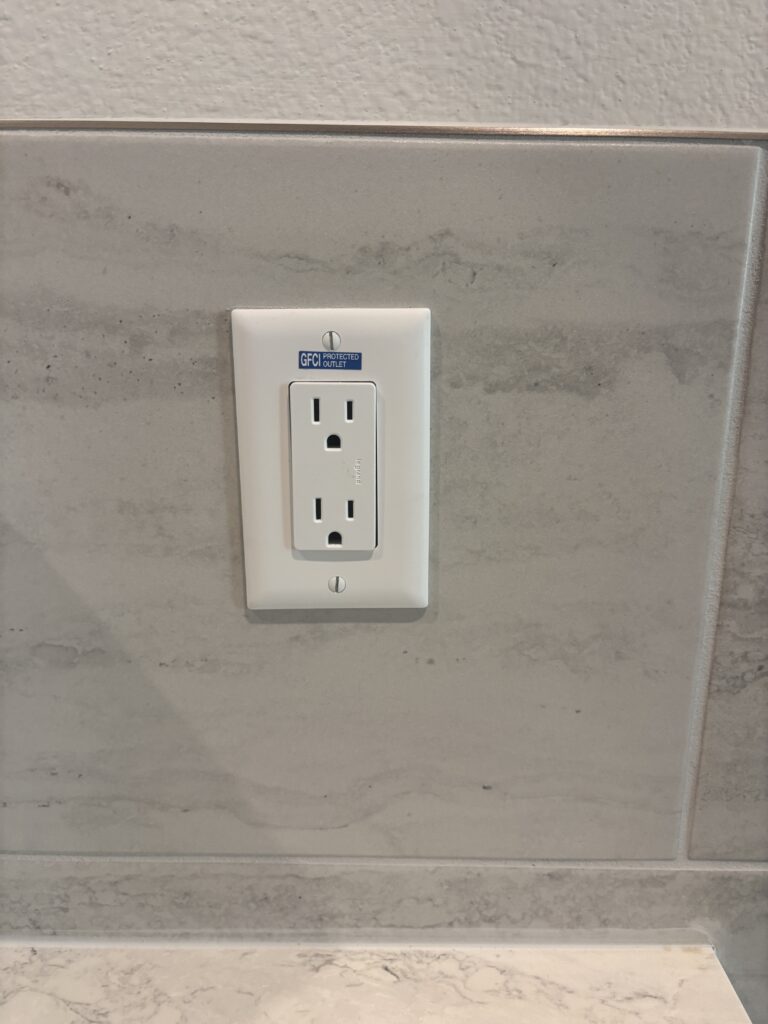
Every outdoor receptacle in a modern home must have GFCI protection, and holiday lighting is exactly the situation that requirement was written to address. A GFCI device monitors the current leaving and returning on a circuit and cuts power within milliseconds when it detects a difference between the two. That difference usually means current is finding a path through water, through a damaged cord, or through a person standing on wet grass. Homes built before the requirement took hold often have exterior outlets with no protection at all. If your outdoor receptacle has only two slots, or if you cannot find test and reset buttons anywhere on that circuit, you likely have no ground fault protection. Adding it is a small job with a very large safety payoff. Press the test button on your GFCI before the season starts and confirm that power actually stops at the outlet.
A GFCI that trips repeatedly is telling you something real about your display or your wiring. Moisture inside a light string socket, a cracked plug, or a damaged cord will all cause the device to open the circuit as designed. Resist the temptation to bypass the protection or move the display over to an unprotected outlet somewhere else. Instead, unplug one string at a time and plug them back in one by one until the trip repeats, which isolates the faulty set quickly. Damp fixtures sometimes dry out and behave normally once the sun comes up, but a set that keeps tripping should be retired for good. Persistent tripping with nothing plugged in at all points to a problem inside the receptacle or the circuit itself. That situation calls for a licensed electrician rather than another trip out to press reset.
Weatherproof covers are the other half of outdoor outlet protection during a long holiday season. Exterior receptacles in damp locations need a cover that keeps water out while a cord is plugged in, commonly called a bubble cover or an in use cover. The older flat flip covers only protect an empty outlet, which does nothing for a display running six weeks straight. Bubble covers cost very little and install in minutes on a standard exterior box. Face the cord opening downward so water runs away from the connection instead of pooling inside the enclosure. Drip loops help as well; leave a low hanging bend in the cord before it reaches the outlet so water follows the loop to the ground. Want ground fault protection on your exterior outlets before the holidays? Click here for our GFCI outlet installation service.
Safe Mounting and Ladder Habits While You Hang Christmas Lights
How you attach lights determines how many of them survive to see next season. Use plastic light clips designed for gutters, shingles, and fascia rather than staples, nails, or screws. A staple driven through the cord jacket can nick a conductor and create a short circuit or a ground fault that shows up weeks later. Clips also let you remove the display in January without tearing the insulation on every string you own. Avoid stretching strings tight between attachment points, since cold weather contracts the wire and puts strain on the sockets. Leave gentle slack along each run so the strings can move with the house and the weather. Keep bulbs away from dry wreaths, fabric decorations, and anything else that traps heat against the string.
Ladder work causes more holiday injuries every year than electricity does. Set the ladder on firm level ground, extend it at least three feet above the roof edge, and have someone hold the base while you climb. Keep both hands free by using a bucket or a tool belt to carry clips and strings up with you. Fiberglass ladders are the right choice near any electrical work because they do not conduct current. Look up before you raise anything, and keep every part of the ladder and your body at least ten feet away from overhead service lines. The service drop entering your house carries full utility voltage, and no breaker in your panel will save you from contact with it. If lights need to go anywhere near that drop, stop what you are doing and call an electrician.
Plan your layout before you start climbing so you are never improvising while standing on a ladder. Measure the roofline, the porch, and the trees, then divide the display into runs that each terminate at a known outlet. Sketch the plan on paper and note which circuit feeds each of those outlets. This is also the right moment to decide where a new outlet would eliminate a long cord run across the yard. Set an outdoor rated timer for each run so the display turns off overnight and reduces total run time. Shorter run time means less heat, less moisture exposure, and a noticeably lower December bill. Store everything by run at the end of the season and next year takes half the time.
Why You Need a Licensed Electrician Before You Hang Christmas Lights This Year
Most holiday displays are a homeowner project, and that works out fine when the circuits can genuinely handle the load. The trouble starts when an older panel, a shortage of exterior outlets, or a missing ground fault device turns decorating into a series of workarounds. Repeated breaker trips, warm receptacles, and long cord runs stretched across the yard are all signs that the electrical system needs attention rather than another extension cord. A licensed electrician can add capacity, install protected outlets where you actually need them, and verify that your panel has room to grow. Handling all of that in the fall is far easier than troubleshooting in the dark on a cold December evening.
When Your Christmas Light Outlets Need an Electrician
Some symptoms are worth acting on immediately rather than waiting to see what happens. A breaker that trips more than once with the same load is not being fussy; it is doing its job on a circuit that is overloaded or faulted. Outlets that feel warm, plugs that spark when inserted, and lights that dim when another device starts all point to a wiring problem. A burning smell near a receptacle means you should shut that circuit off at the panel and call for help right away. These signs rarely resolve on their own, and December is when marginal circuits finally give out. Catching them early keeps a small repair from turning into a much larger rewiring job.
Older homes around Angleton and Brazoria often have panels and circuits designed for a much smaller electrical load than families use today. Two prong outlets, aluminum branch wiring, and undersized service panels are all common in houses built before the 1980s. Adding a large holiday display to that kind of system stresses equipment that was already working hard year round. A professional inspection identifies the weak points and gives you a clear list of what needs attention first. It also documents the current condition of your system, which helps for insurance and resale purposes. An electrician can walk the system with you and explain plainly what matters now and what can safely wait.
Panels themselves deserve a careful look before the holiday season starts. Rust, moisture, double tapped breakers, and scorch marks inside the enclosure are all reasons to call a professional rather than add another load. A panel with no open spaces limits what you can add for outdoor outlets or any future project. Upgrading a panel takes planning and a permit, so starting in the fall gives you time to schedule the work without rushing. Waiting until a breaker fails puts you at the back of the line during the busiest month of the year.

Adding Dedicated Outdoor Outlets for Christmas Lights
The cleanest solution to holiday overloading is a dedicated exterior circuit built specifically for the job. A dedicated 20 amp circuit feeding weatherproof outlets gives your display roughly 1,920 continuous watts with nothing else competing for the capacity. Placement matters as much as capacity, so the outlets go where the display actually is rather than wherever the builder happened to put one. Common locations include the eaves for roofline lighting, the porch columns, and a post near the driveway or the main yard display. Eave outlets controlled by a switch inside the house remove the ladder from your routine entirely. Once the circuit exists, every future season becomes a matter of hanging lights and flipping a switch.
Dedicated outdoor circuits pay off well beyond the month of December. The same outlets power landscape lighting, yard tools, pressure washers, and outdoor entertaining throughout the rest of the year. A properly sized circuit also protects the rest of your home by keeping heavy seasonal loads off the garage and kitchen circuits. Adding a circuit requires open space in the panel, correctly sized conductors, and ground fault protection at either the outlet or the breaker. It is straightforward work for a licensed electrician and it permanently eliminates the extension cord maze. Ready to stop running cords across the yard every winter? Click here for our dedicated circuit installation service.
Surge protection belongs in the same conversation as new outdoor circuits. Holiday displays add a large amount of connected electronics, from timers and controllers to projectors and inflatable blowers. Gulf Coast storms and routine utility switching send voltage spikes down the service line that can destroy those devices instantly. A whole house surge protective device installed at the panel takes the first hit and shields everything downstream from it. It is a small addition that protects far more than a string of lights.
Why Choose Schultz Family Electric for Your Christmas Light Outlets
Schultz Family Electric is based in Angleton and works across Brazoria County every single day. We know the housing stock here, from older farmhouses on county roads to newer builds in Pearland, Manvel, and Lake Jackson. Being local means shorter drive times and real availability during the weeks when everyone needs help at once. When you call, you reach an actual person on our team instead of an automated menu. That direct line matters when a breaker will not reset and your family is standing in a dark living room.
We are fully licensed under number 748217, and every job carries a lifetime craftsmanship warranty. Our diagnostic fee is waived when you choose us to handle the repair, so you know all of your options before any work begins. You get a clear explanation of what we found, what it will cost, and what happens next. There are no upsells and no pressure to buy equipment you do not need. We are electricians for life, not for the day, and repeat customers are how this business has grown.
Getting your outdoor electrical squared away before the holidays is one of the easiest ways to make the season simple. We can add weatherproof outlets, install GFCI protection, run a dedicated circuit for your display, and confirm your panel is ready for the load. Scheduling in the fall means the work is finished long before the first string of lights goes up. Call Schultz Family Electric at (979) 264-9024 or email info@schultzfamilyelectricllc.com to set up a visit. One afternoon of preparation now saves you a season of tripped breakers and cold ladder trips later.