How To Avoid Tripped Breakers While Cooking Thanksgiving Dinner
Thanksgiving asks more of your kitchen wiring than any other day on the calendar, and most homeowners never think about that until the lights go out with a turkey half cooked. A single kitchen countertop can easily host a roaster oven, an air fryer, a coffee maker, and a warming tray at the same time, and each of those appliances pulls serious current the moment it is switched on. Breakers are safety devices, so when one trips during dinner prep, it is doing exactly what it was designed to do; it is telling you the circuit is carrying more load than the wiring behind the wall can safely handle. The frustrating part is the timing, because trips almost always happen at the worst possible moment, right when three dishes are running and guests are pulling into the driveway. The good news is that nearly every Thanksgiving breaker trip is predictable, and predictable problems can be prevented with a little planning and, in some homes, a small amount of electrical work done ahead of time. Older houses across Brazoria County were wired for a very different set of appliances than the ones sitting on kitchen counters today. Understanding how your kitchen circuits are laid out, how much power your appliances actually draw, and when a trip signals a real problem will keep your holiday cooking on schedule and your family safe.
Why Tripped Breakers Happen While Cooking Thanksgiving Dinner
Tripped breakers on Thanksgiving come down to three root causes: too much load on one circuit, wiring that has aged past its safe working condition, and breakers or connections that have started to fail. Modern electrical code requires at least two dedicated 20 amp small appliance branch circuits to serve kitchen countertop receptacles, but many homes built decades ago were wired with a single general purpose circuit feeding the entire kitchen. Even in newer homes, those two circuits fill up fast when holiday cooking begins, because a 20 amp circuit should only carry about 16 amps of continuous load, which works out to roughly 1,900 watts. A roaster oven alone can pull 1,450 watts, and an air fryer commonly pulls 1,500 watts, so plugging both into outlets on the same circuit guarantees a trip. Add a coffee maker and a stand mixer and the math stops working entirely. Knowing why breakers trip helps you decide when to simply move a plug and when to call an electrician.
The Kitchen Circuit Overload That Trips Breakers on Thanksgiving
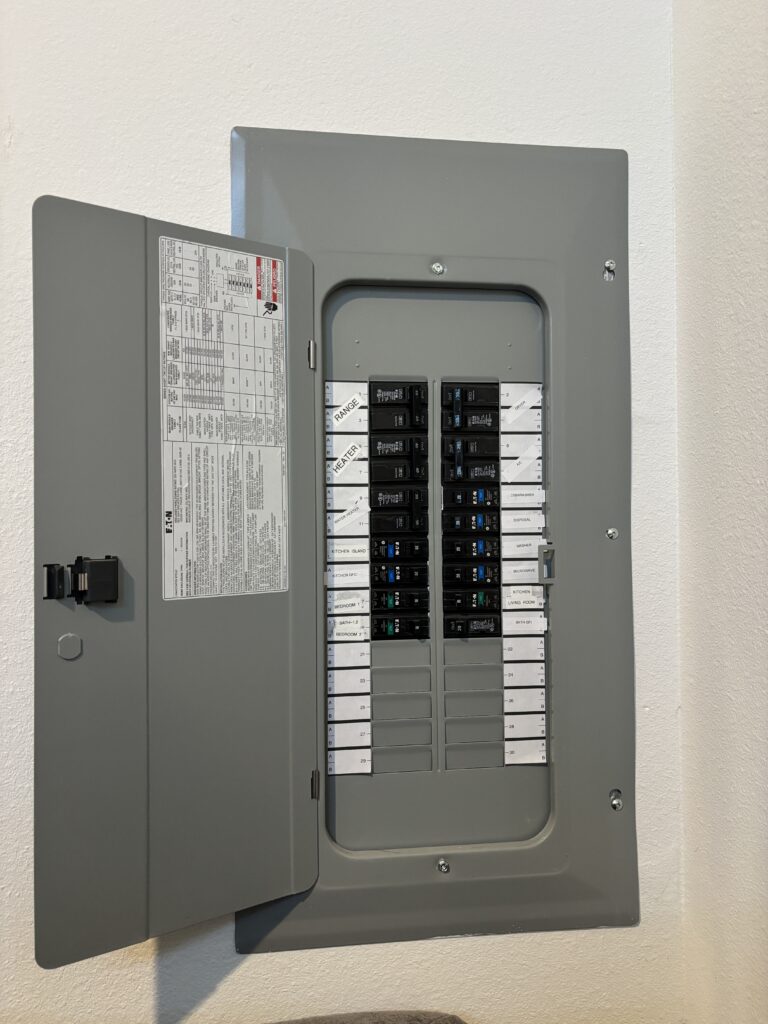
Overload is by far the most common reason a breaker trips while Thanksgiving dinner is being prepared, and it happens because kitchen outlets do not work the way most people assume they do. Two outlets on opposite sides of a kitchen can share the same circuit, and two outlets right next to each other can be on completely different circuits, since the layout depends entirely on how the electrician ran the cable when the house was built. That means unplugging an appliance and moving it four feet down the counter sometimes solves the problem and sometimes changes nothing at all. To plan around it, you need to know which receptacles share a breaker, and the simplest way to find out is to turn off one breaker at a time and walk the kitchen with a lamp or a plug in tester. Write the results directly inside your panel door so you have the map on hand every year. That single step turns holiday cooking from a guessing game into a schedule you can actually manage.
The wattage numbers behind the overload are worth understanding, because they explain why the trip feels so sudden. Countertop cooking appliances are resistive heating loads, which means they convert nearly all the electricity they draw into heat and they pull their full rated wattage the entire time they are on. An electric griddle runs about 1,500 watts, a toaster oven runs between 1,200 and 1,800 watts, a large coffee maker pulls close to 1,200 watts during the brew cycle, and a countertop roaster can exceed 1,600 watts while it preheats. Divide any of those numbers by 120 volts and you get the amperage, so a 1,500 watt air fryer is drawing 12.5 amps by itself. Two of those on one 20 amp circuit puts you at 25 amps on wiring rated for 20, and the breaker will open the circuit within seconds. Slow cookers and warming trays are the exception, since most draw between 200 and 300 watts, which makes them the safest appliances to leave running on a shared circuit all afternoon.
Timing matters just as much as placement, and this is where most Thanksgiving overloads sneak up on people. Many appliances cycle on and off to hold temperature, so a circuit that seems perfectly stable for twenty minutes can trip the instant three heating elements happen to energize at the same moment. The refrigerator compressor kicking on, the microwave starting, and the coffee maker beginning a fresh brew can align by pure coincidence and push the circuit past its limit. Staggering start times solves this without any electrical work at all, so start the roaster first, brew coffee before the side dishes go in, and hold off on the air fryer until the griddle has finished. Keep the refrigerator on its own circuit and never plug a cooking appliance into an outlet you know the refrigerator shares. A little sequencing keeps the total draw under control even in a kitchen with limited circuits.

Old Wiring and Tripped Breakers During Thanksgiving Dinner Prep
Age is the second major factor behind tripped breakers on Thanksgiving, and it shows up in homes built before kitchens were expected to run six appliances at once. Houses wired in the 1950s and 1960s often have two prong ungrounded receptacles, cloth insulated conductors, and a service panel sized at 60 or 100 amps for the entire home. Aluminum branch circuit wiring installed in many homes during the late 1960s and early 1970s presents its own hazard, because aluminum expands and contracts more than copper and loosens connections at outlets and switches over time. Loose connections create heat, heat degrades the connection further, and the cycle continues until you have a genuine fire risk hidden inside a wall box. A breaker that trips repeatedly in an older kitchen should never be treated as a simple inconvenience. It is often the only warning sign a homeowner gets before something more serious happens.
Backstabbed receptacles are another common issue in older and even fairly recent construction, and they cause holiday trips that look exactly like overloads. Backstabbing refers to pushing the wire into a small hole in the back of the outlet rather than wrapping it around the screw terminal, and the internal spring that holds the wire loses tension as it ages. Under a heavy load like a roaster oven, that weak connection heats up, resistance climbs, and the outlet can discolor, buzz, or fail entirely. If you notice a warm faceplate, a scorched smell, or a plug that falls loose when you tug it, stop using that receptacle and have it inspected. Replacing failing receptacles and moving the connections to screw terminals is inexpensive work that dramatically improves reliability. It is one of the most cost effective upgrades an older kitchen can receive.
Undersized service capacity ties all of these older wiring problems together. A 100 amp panel that supported a 1965 household with one oven, one refrigerator, and a window air conditioner is now being asked to run a central HVAC system, an electric range, a dishwasher, a microwave, an electric water heater, and a garage full of tools. When the whole house is close to its limit, the kitchen circuits are the first to complain because they carry the highest concentrated load on a holiday. Upgrading to a 200 amp service creates room for additional circuits and eliminates the constant juggling act. If your panel is full, has no open slots, or relies on tandem breakers stacked into every available space, capacity is your real problem. Planning a service upgrade in the fall means the work is finished long before the holiday cooking starts.
Failing Breakers That Trip Before Thanksgiving Dinner Is Served
Breakers are mechanical devices with a finite service life, and a worn breaker will trip at loads well below its rating. The thermal element inside a standard breaker relies on a bimetallic strip that bends as it heats, and decades of repeated tripping fatigue that strip until it responds too early. A homeowner experiencing this sees a 20 amp breaker trip while a single 1,200 watt coffee maker is running, which makes no sense on paper and is a clear sign the breaker itself has failed. Replacing a worn breaker is straightforward work for a licensed electrician, but it must be matched to the panel manufacturer and the circuit conductors. Installing a larger breaker to stop the tripping is dangerous and illegal, because the breaker protects the wire, not the appliance. A 20 amp breaker on 14 gauge wire allows the conductor to overheat inside the wall without ever tripping.
Ground fault and arc fault protection add another layer that homeowners often misread as a bad breaker. Kitchen countertop receptacles have required GFCI protection for decades, and current code extends that protection to essentially all kitchen receptacles along with dishwashers and other appliances. Arc fault protection has been required in kitchens since the 2014 code cycle in most jurisdictions. These devices watch for very different problems than an overload, so a GFCI trip means current is leaking to ground somewhere, often from a damaged cord, a wet plug, or an appliance with a failing heating element. If a GFCI trips every time you plug in the same slow cooker, the slow cooker is the problem and it should be retired. Repeated GFCI trips with nothing plugged in point to a wiring fault that needs professional attention.
Knowing how to tell these trips apart saves a lot of holiday stress. An overload trip happens under heavy load, resets cleanly at the panel, and holds once you reduce the load. A GFCI trip resets at the outlet itself using the small reset button, not at the panel. A short circuit trip happens instantly, often with a pop or a visible spark, and the breaker will refuse to hold when reset, which means you should leave it off and call an electrician immediately. Never reset a breaker more than once if it will not hold, and never tape or wedge a breaker into the on position. Is a breaker in your kitchen tripping over and over? Click here for our circuit breaker repair service.
How To Prevent Tripped Breakers While Cooking Thanksgiving Dinner
Preventing tripped breakers while cooking Thanksgiving dinner comes down to planning your appliance layout, adding capacity where your kitchen genuinely needs it, and checking the system before the holiday arrives rather than during it. Most families can avoid trips entirely by mapping their circuits, spreading heat producing appliances across separate circuits, and staggering when each one runs. Homes that host large gatherings every year usually benefit from something more permanent, and that means adding dedicated circuits sized for the appliances that actually get used. A dedicated circuit serves one appliance and nothing else, which removes the guesswork completely and eliminates the shared load problem at its source. The work is usually straightforward, especially if the panel has open capacity and the kitchen is accessible from an attic or crawl space. Handled in advance, it turns the busiest cooking day of the year into an ordinary one.
Spreading Appliance Loads To Prevent Tripped Breakers on Thanksgiving
The most effective free strategy for preventing tripped breakers on Thanksgiving is deliberate load distribution across every circuit available to you. Start by listing every appliance you plan to run, then write down the wattage from the label on the bottom or back of each unit. Group them so that no single 20 amp circuit carries more than about 1,900 watts at any given moment, and give yourself a margin below that number rather than aiming for the ceiling. High draw items like roasters, air fryers, and griddles should never share a circuit with each other. Pair one high draw appliance with low draw items such as a slow cooker, a stand mixer, or a warming tray. Written out on paper the night before, this plan takes ten minutes and prevents nearly every common trip.
Look beyond the kitchen for additional capacity, because adjacent rooms almost always sit on separate circuits. A dining room outlet, a nearby hallway receptacle, or a garage outlet can carry a roaster oven comfortably while the kitchen circuits handle everything else. Use a heavy duty extension cord rated for the appliance load, meaning 12 gauge for anything drawing 1,500 watts or more, and keep the cord as short as the distance allows. Never run a cooking appliance through a light duty household extension cord, because a thin cord under heavy load becomes a heat source and a fire hazard. Do not run cords under rugs, across doorways, or through areas where guests will be walking. Power strips and surge protectors are not rated for heating appliances at all and should never be used for a roaster, griddle, or air fryer.
Keep the appliances themselves in good condition, since a struggling appliance draws more current than a healthy one. Clean the coils behind and beneath your refrigerator before the holiday so the compressor runs efficiently instead of cycling constantly under load. Inspect every cord you plan to use for cracked insulation, exposed conductors, bent prongs, or connectors that feel loose in the outlet. An appliance that blows a breaker consistently no matter which circuit it is plugged into has an internal fault and should be repaired or replaced rather than used. Pay attention to outlets that feel warm, buzz faintly, or spark when a plug is inserted, and stop using them until an electrician has looked at them. Small maintenance habits like these carry a surprising amount of weight on a day when everything is running at once.
Dedicated Circuits That Prevent Tripped Breakers While Cooking
A dedicated circuit is the permanent fix for a kitchen that trips every holiday, and it is the single best investment for a household that entertains often. The circuit runs from its own breaker in the panel directly to one receptacle or one appliance, so nothing else can compete for the available amperage. Code already requires dedicated circuits for the range, the dishwasher, the garbage disposal, and in most cases the microwave and refrigerator, but those requirements do not account for the countertop appliances families actually use on Thanksgiving. Adding one or two dedicated 20 amp circuits with GFCI protection to the areas of the counter where you cook gives you room for a roaster and an air fryer running simultaneously. In homes where the panel has open slots and the kitchen is reachable from above or below, the work often takes less than a day. The improvement is immediate and permanent.
Placement of new circuits deserves careful thought, because a dedicated circuit only helps if the outlet is where you actually need it. Walk your kitchen and think about how you use the space on a busy day, noting which stretch of counter holds the roaster, where the coffee station lives, and which corner ends up with the warming tray. An island with no receptacle forces cords to stretch across walkways, which is both a code concern and a real tripping hazard when the house is full of people. Adding outlets in the right spots removes the need for extension cords entirely. Discuss your holiday cooking routine with your electrician so the design matches how you cook rather than a generic layout. The result is a kitchen that works with you instead of against you.
Panel capacity determines what is possible, so an evaluation should come before any new circuits are planned. An electrician will check the available slots, the bus rating, the condition of the breakers, and the total connected load already present in the home. Panels manufactured by Federal Pacific and Zinsco are known to have serious failure issues and should be replaced regardless of how they appear from the outside, since their breakers have a documented history of not tripping when they should. If the panel is full, a service upgrade or a subpanel provides the room needed for kitchen improvements and future additions like an electric vehicle charger. Handling the panel and the new circuits together is more efficient than doing them separately a year apart. Tired of juggling appliances every holiday? Click here for our dedicated circuit installation service.
An Electrical Check Before Thanksgiving That Prevents Tripped Breakers
A short electrical check in the weeks before Thanksgiving catches the problems that would otherwise surface at the worst possible time. Begin at the panel, where every breaker should be clearly labeled, seated firmly, and free of rust, corrosion, or any burnt smell. Feel the panel cover with the back of your hand, since a warm spot indicates a loose connection or an overloaded circuit that needs immediate attention. Listen for buzzing or crackling, both of which point to arcing that requires a licensed electrician right away. Confirm that nothing is stored against the panel and that you have clear working space in front of it, because you may need fast access on the holiday itself. These checks take a few minutes and require no tools.
Move next to the outlets and switches throughout the kitchen and dining area. Press the test button on every GFCI receptacle to confirm that it trips and resets properly, and replace any device that fails the test or that is more than ten to fifteen years old. Plug a lamp into each countertop outlet to verify it is live and that the plug fits snugly rather than sliding loose. Look closely at faceplates for discoloration, cracks, or scorch marks around the slots, since any of those signs means the receptacle has been running hot. Check that outlets near the sink and any wet area have working GFCI protection, which is both a code requirement and a genuine safety measure with wet hands and dish towels in constant motion. Anything questionable should be addressed before guests arrive.
Finish by testing the loads you actually intend to run, which is the step most homeowners skip. Set up your appliances the way you plan to use them on Thanksgiving, turn everything on at the same time, and let it run for fifteen or twenty minutes. If a breaker trips during that trial, you have found the problem with a full week to fix it rather than a full turkey to save. Note which combinations work and which do not, then keep that list with your recipes for future years. Test your smoke detectors while you are at it, since kitchen activity and open flame are far more common on Thanksgiving than any other day. A practice run removes almost all of the risk from the real thing.
Why You Need an Electrician Before Thanksgiving Dinner Cooking Begins
Some Thanksgiving electrical problems can be solved by moving a plug, and some cannot be solved safely by a homeowner at all. Repeated trips, warm outlets, buzzing panels, scorch marks, and breakers that refuse to reset are all signals that something behind the wall needs professional attention. A licensed electrician can measure actual circuit loads, find loose connections that are invisible from the outside, and correct the underlying issue rather than working around it. Waiting until the holiday itself limits your options and turns a routine repair into an emergency call. Scheduling in advance means the work is done properly, inspected where required, and finished long before the first guest arrives.
What a Licensed Electrician Fixes Before Thanksgiving Cooking Starts
A licensed electrician brings diagnostic tools that reveal problems no visual inspection can find. A clamp meter shows the real amperage a circuit is carrying under load, which turns guesswork into a number you can plan around. Thermal imaging finds hot spots at breakers, terminals, and receptacles where a connection has begun to fail. Circuit tracing identifies exactly which outlets share a breaker so your appliance plan is based on fact rather than assumption. That information alone often prevents every trip a household has been fighting for years.
The repairs that follow are usually smaller than homeowners expect. Replacing worn receptacles, tightening loose terminations, swapping a failed breaker, or adding one properly sized circuit resolves the majority of kitchen problems. Larger issues like an undersized service, an obsolete panel, or aging aluminum branch wiring take more work but deliver a lasting improvement to the entire home. An electrician can also confirm that your kitchen meets current GFCI and arc fault requirements, which matters for both safety and any future home sale. Everything gets done to code, with the right materials and the right connections.
Timing is the part that homeowners control. Electrical contractors book up quickly in November, and the week of Thanksgiving is the hardest time to find an opening. Calling in early fall gives you a normal appointment, a proper diagnosis, and enough time for any parts that need to be ordered. It also lets you spread the work out if the panel and the kitchen circuits both need attention. Planning ahead is always less expensive and less stressful than reacting.

Emergency Electrical Help During Thanksgiving Dinner
Even with good preparation, things occasionally go wrong on the holiday itself, and knowing what to do keeps a bad moment from becoming a dangerous one. If a breaker trips and will not reset, leave it off and stop using that circuit entirely. If you smell burning plastic, see smoke, or notice sparking at an outlet, shut off the circuit at the panel immediately and keep everyone away from that area. Do not attempt to repair a hot circuit yourself with a house full of guests. A total loss of power to part of the home can indicate a failed main breaker, a utility issue, or a serious service problem.
Certain warning signs mean you should call for help right away rather than waiting until the following week. Burning odors, visible arcing, outlets or faceplates that are hot to the touch, and panels that buzz loudly all fall into that category. Lights that dim noticeably every time an appliance starts point to a loose neutral or an overloaded service, both of which can damage electronics throughout the house. A breaker that trips instantly and repeatedly indicates a short circuit somewhere in the wiring. These are not problems to live with through a long weekend.
Having a trusted electrician’s number saved in your phone before the holiday makes a real difference when minutes matter. Emergency electrical service exists precisely for the situations that do not wait for business hours. A qualified electrician can isolate the fault, restore safe power to the rest of the home, and make a permanent repair as soon as parts allow. Need help fast when something goes wrong? Click here for our emergency electrician service.
Why Choose Schultz Family Electric for Thanksgiving Kitchen Electrical Work
Schultz Family Electric is based in Angleton and works throughout Brazoria County every day, which means we know the housing stock, the common panel types, and the wiring practices used in this area across every era of construction. We are fully licensed under number 748217, and every job we complete carries a lifetime craftsmanship warranty. When you call, a real person answers, and you get direct help from someone who understands electrical work rather than an automated menu. Our diagnostic fee is waived when you choose us to handle the repair, so you know your options and your costs before any work begins.
We build lasting relationships with the families we serve instead of chasing one time sales. That means honest recommendations, clear explanations, and no pressure to buy work your home does not need. If moving one appliance to another circuit solves your problem, that is what we will tell you. If your panel is genuinely undersized or your kitchen needs an additional circuit, we will explain exactly why and what it will take to fix it. Our trained professionals handle every install and stand behind the work long after the truck pulls away.
Do not spend another Thanksgiving resetting breakers in the dark while dinner cools on the counter. Schedule your kitchen electrical evaluation now and give us time to make the improvements your home needs before the holiday arrives. We serve Angleton, Lake Jackson, Pearland, Alvin, Manvel, Clute, Freeport, Brazoria, and the surrounding communities with fast response times and real familiarity with local electrical needs. Call Schultz Family Electric today at (979) 264-9024 to get your kitchen ready for the biggest cooking day of the year.